South Africa Builds Cars: Why Its Vehicles Don't Reach Us
Rédaction MotoNaMarket · 2026-08-07
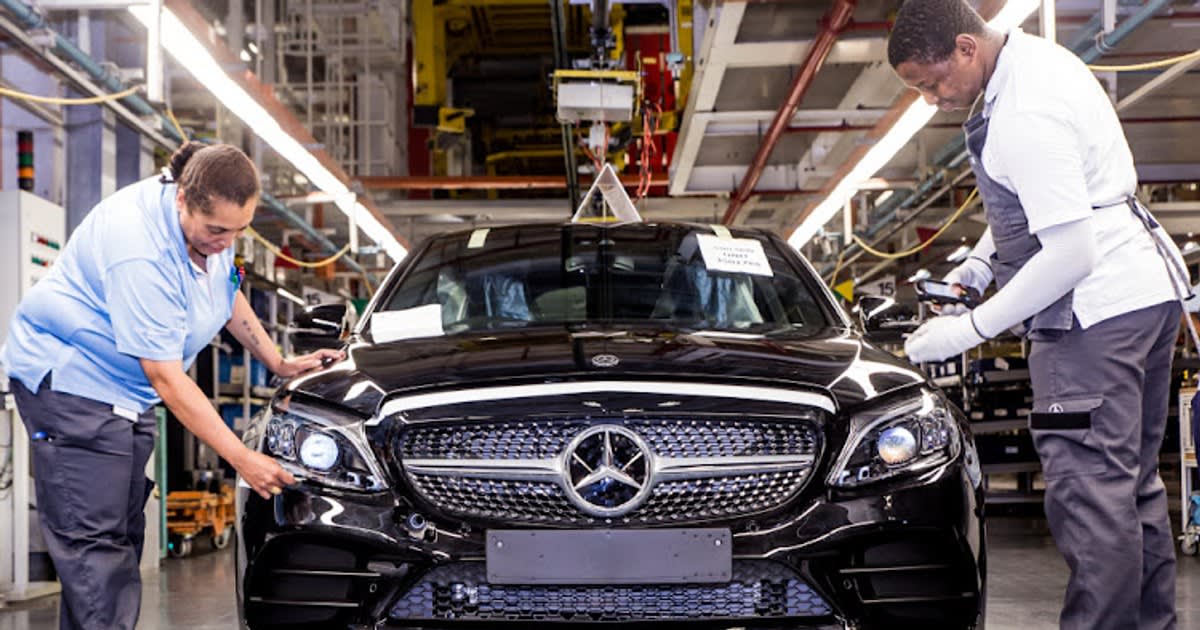
South Africa assembles vehicles for global manufacturers and exports worldwide — except to us. The driving side and the new-vehicle barrier explain why, and what actually concerns you: parts.
Here is a question few people ask that deserves a real answer: if the African continent hosts a car industry capable of producing hundreds of thousands of vehicles a year, why does Cameroon import its cars from Europe and North America?
That industry does exist, in South Africa. It assembles for global manufacturers and exports to dozens of countries. Yet a buyer in Douala or Yaoundé has practically no access to it. This article explains why, and what that situation means in practice.
The only African country building at scale
South Africa occupies a unique position on the continent. Several global manufacturers run full assembly plants there, not simply kit-assembly lines.
That difference is fundamental. Assembling a vehicle from imported components is a logistics activity. Building one with a local supplier base — pressing, upholstery, tyres, electronics, glass — is an industrial activity that presupposes decades of accumulated know-how.
The country therefore produces both for its domestic market and for export, including to Europe and Asia. It is the only African economy exporting finished vehicles in volume to developed markets.
The main reason: which side of the road
Here is the central explanation, and it is simpler than people imagine.
South Africa drives on the left, in right-hand-drive vehicles. Cameroon drives on the right, in left-hand-drive vehicles.
The South African vehicle park — the used cars circulating, ageing and eventually being resold — is therefore composed entirely of vehicles unusable here.
It is the same barrier that separates Cameroon from the Japanese market, explained in our guide to import channels. Geographic proximity and vehicle quality are irrelevant: a right-hand-drive park cannot feed a left-hand-drive market.
That barrier explains much of African automotive geography. Southern and East Africa, driving on the left, trade with each other and source from Japan. West and Central Africa, driving on the right, source from Europe and North America. They are two parallel worlds that rarely intersect.
But the plants also build left-hand drive
Here the picture becomes more interesting, and it qualifies what precedes.
A South African plant producing for export builds vehicles suited to their destination market. A car built there for continental Europe is left-hand drive, since continental Europe drives on the right.
Left-hand-drive vehicles therefore do leave South Africa. But they are new vehicles, straight from the factory, sold at new prices and destined for established distribution networks.
This is where the second barrier appears, and it is economic rather than technical.
The new-vehicle barrier
The Cameroonian market, like most of its neighbours', rests overwhelmingly on imported used cars. The majority of transactions involve vehicles already several years old with a first owner elsewhere.
A new vehicle, whatever its origin, sits in a price band that concerns only a minority of buyers. That it comes from Pretoria rather than Stuttgart does not change that reality: it is still a new vehicle.
In other words, the South African industry and the Cameroonian used market do not meet because they simply do not serve the same demand. This is not a customs problem, a transport problem or a question of political will: it is a question of segment.
Recognising a steering conversion
Since converted vehicles do circulate, it is worth knowing how to spot one. A careful conversion can be discreet, but it almost always leaves traces.
The dashboard. Look for fit inconsistencies, exposed screws, or a slightly different texture or shade between the two halves of the fascia.
The wipers. On an original vehicle the sweep is designed to clear the driver's view. A sweep leaving a blind spot on the driver's side often betrays a conversion.
Pedals and column. A displaced assembly, welds or added brackets under the dashboard are clear signs.
Traces on the opposite side. Check whether drillings, blanking plugs or mounting marks remain where the original steering sat.
Airbags. This is the most serious point: a driver's airbag moved or replaced without approval will not necessarily deploy as designed.
That last point alone justifies caution. A conversion touches safety components designed and tested in a specific configuration. Always have a suspect vehicle examined by a verified mechanic before considering purchase.
Japan and South Africa: the same wall
It is useful to set these two markets side by side, because they illustrate the same constraint in very different forms.
Japan is the world's largest exporter of used vehicles. South Africa is Africa's largest manufacturer. Neither feeds the Cameroonian used market, and for exactly the same reason: their parks drive on the left.
That symmetry is worth noting, because it shows the barrier is not about distance, cost or quality. It is a purely technical constraint that divides the world market into two largely sealed blocs.
For a Cameroonian buyer the practical conclusion is clear: when you read buying advice or a price comparison online, first check which bloc the author is writing about. Excellent advice written for Nairobi or Cape Town can be entirely inapplicable in Douala.
What this says about the industrial model
The South African case illuminates a question raised in relation to Ghana: can a car industry be developed in a country dependent on imported used vehicles?
The South African experience suggests three conditions must be met, and that none is optional.
Condition | Why it is necessary |
|---|---|
A sufficient domestic market | A plant needs guaranteed volume to amortise its investment |
A supplier base | Without local subcontracting, assembly is disguised importing |
A skilled, stable workforce | Industrial know-how accumulates over decades, not over a five-year plan |
These conditions explain why automotive industrial development in West Africa advances slowly despite sometimes generous incentives. The problem is not will: it is that the three conditions are built together, and slowly.
What might change, and what will not
Continental trade integration projects aim precisely at the first constraint, widening the market accessible to an African producer beyond its national borders.
The idea is sound on paper: a manufacturer established somewhere on the continent could sell into several countries without prohibitive duty at every frontier, which changes the volume equation.
It is worth staying clear-eyed about what that does not solve. Which side of the road is not negotiable: whatever the trade regime, a right-hand-drive car remains unsuited to a country driving on the right. And trade integration does not turn a new vehicle into one a used-car buyer can afford.
What might therefore change concerns mainly new vehicles and, more immediately, spare parts.
Parts: the flow that already exists
This is the most directly useful point in the article, and the least known.
A car industry does not only produce vehicles: it produces and commissions components. A supplier base built to feed assembly lines makes parts that are not necessarily specific to one side of the road.
Many components know no difference between right- and left-hand drive: filters, belts, pads, discs, dampers, batteries, engine and transmission components, a large share of consumables. These circulate, including towards left-hand-drive markets.
For a Cameroonian buyer the consequence is concrete: the presence of a continental industry influences the availability and price of certain parts, even where it does not influence the supply of vehicles. Check what you find on our spare parts marketplace before assuming a part must come from Europe.
Which African markets are compatible with ours
If South Africa and East Africa are out of reach, it is fair to ask who Cameroon actually shares a possible market with.
The answer follows the map of driving sides. Francophone and lusophone West and Central Africa drive overwhelmingly on the right, as we do: Senegal, Côte d'Ivoire, Ghana, Nigeria, Benin, Togo, Gabon, Congo, Chad, the Central African Republic. It is within that set that vehicles can move between countries without a technical obstacle.
That does not make such trade simple: every border adds formalities, duty and delay, as detailed for Nigeria. But at least the obstacle is administrative, and therefore surmountable, rather than technical.
For a buyer this mental map has immediate use: it tells you which advice found online can apply to you. A guide written in Abidjan or Accra is probably describing vehicles comparable to yours. A guide written in Nairobi, Kampala or Johannesburg is describing another world.
What right-hand drive is worth in Cameroon
The question has to be asked in resale terms, because that is where reality shows up.
A right-hand-drive vehicle in Cameroon suffers a severe discount, for a simple reason: the pool of potential buyers is very small. An asset with weak demand does not resell at the price of an equivalent asset with normal demand, whatever its mechanical quality.
Practical difficulties add to that: insurance sometimes harder to arrange, dangerous overtaking on two-lane roads, toll booths and service windows on the wrong side, and a local market for side-specific parts that barely exists.
The conclusion is clear: even where such a vehicle appears at a very attractive price, the full calculation rarely favours it. You buy at a discount and you will resell at a steeper one.
What the Cameroonian buyer should take from this
Three practical conclusions emerge, and none requires waiting for the market to evolve.
Do not go looking for a South African used car
If a seller offers you a used vehicle presented as coming from South Africa, the question of which side the wheel is on must be asked immediately. A right-hand-drive vehicle is hard to insure, hard to resell, and dangerous to overtake in on our roads.
Conversions exist, but converting the steering is heavy work that touches safety. It changes the position of the steering components, the column, sometimes the dashboard and the airbags. A converted vehicle should be treated with the same caution as a structurally repaired one.
Do not compare markets that are not comparable
South African prices, often quoted online, are not a reference for Cameroon. These are two markets separated by a technical barrier no commercial arbitrage crosses.
To place a price here, compare against vehicles actually available in Cameroon, or use our price estimator, which calculates from Cameroonian listings.
Look at parts instead
This is where the continental industry can concern you directly, today. Before ordering a part from abroad with the delay and cost that involves, check what is available locally and regionally.
The parts that do depend on the side
We said many parts ignore the driving side. It is worth specifying which ones do not, to avoid a wasted order.
Indifferent to driving side | Specific to driving side |
|---|---|
Filters, belts, plugs | Steering rack and column |
Pads, discs, calipers | Dashboard and associated loom |
Dampers, springs | Pedal box and master cylinder |
Batteries, alternators, starters | Wiper arms and linkage |
Engine and gearbox components | Airbags and fascia trim |
The simple rule: anything touching steering, driver controls or the safety of the driving position is specific; anything touching the mechanicals, braking or suspension generally is not.
This is why a converted vehicle remains problematic even when it drives well: it is precisely the side-specific components, and therefore the hardest to replace correctly, that have been moved.
How that industry was built
One final point deserves understanding, because it illuminates current West African debates.
The South African industry did not establish itself spontaneously. It developed over several decades, through successive policies combining domestic market protection, local content requirements and export incentives. Manufacturers produced there because producing became more attractive than importing.
That model carries a cost people often forget: during protection phases, local buyers pay more for vehicles than they would on an open market. It is a transfer from the buyer to the industry, accepted in exchange for jobs and skills.
This is exactly the trade-off described in relation to Ghana, and it is why such policies are contested everywhere: the benefit is collective and deferred, the cost individual and immediate.
Buying new in Cameroon: when it makes sense
Since South African production only reaches us as new vehicles, it is worth treating the new-car question honestly — it is rarely discussed in a market dominated by used cars.
Buying new costs considerably more up front and takes the steepest depreciation in the first years. For a private buyer choosing a family car, a recent used vehicle remains almost always the rational choice.
The calculation changes in three situations. For intensive professional use, reliability and warranty limit downtime, which is the real cost as shown in our analysis of operating profitability. For a company, depreciation treatment and image carry weight. And for a model whose used examples are rare or invariably tired, new sometimes becomes the only reliable route.
The point is not that new is bad, but that it answers a different need. Compare it against what it genuinely replaces — an equivalent recent used vehicle — rather than against the cheapest used car on the market.
A note on where these vehicles do go
If South African used cars do not come to us, it is reasonable to ask where they go, because the answer confirms the whole argument.
They move within the left-hand-drive bloc. Southern African neighbours share both the driving side and, in several cases, customs arrangements that make the trade straightforward. Beyond the region, right-hand-drive markets further afield can absorb them for the same reason Japan supplies East Africa: the wheel is on the compatible side.
The pattern is worth noticing because it is the clearest demonstration that used-vehicle flows follow the driving side before they follow distance, price or diplomacy. A car in Johannesburg is closer to Nairobi than to Douala in every sense that matters commercially, despite Douala being no further away on a map.
For anyone reading market analysis about Africa, that single distinction resolves a surprising amount of apparent contradiction — why some countries share price trends and others never do, and why supply shocks in one part of the continent leave another entirely unaffected.
Summary
South Africa is the only African country building vehicles at scale, with a local supplier base.
Its used park is right-hand drive: it cannot feed Cameroon.
Its plants also build left-hand drive, but only as new vehicles.
The Cameroonian market rests on used cars: the two segments do not meet.
An industry requires a domestic market, suppliers and a skilled workforce, built together over decades.
Trade integration can widen the new-vehicle market; it cannot cross the driving-side barrier.
Parts, however, already circulate: that is the most concrete effect for you.
In closing
The answer to the opening question is almost disappointingly simple: South African cars do not come here because the wheel is on the wrong side, and the ones with the wheel on the right side are new.
That technical constraint, invisible in debates about industrialising the continent, explains more of African automotive geography than most economic analysis does. It is also a reminder that before comparing two markets, it is worth checking they are comparable.
To start: place a price with our estimator, look for parts on the spare parts marketplace, and have any vehicle of unusual origin checked by a verified mechanic.
Frequently asked questions
Can you import a used car from South Africa to Cameroon?
Technically yes, but it would be a poor choice: South Africa drives on the left, so its used park is right-hand drive. Such a vehicle is hard to insure, hard to resell and dangerous to overtake in here. Steering conversions exist but touch on safety and should be treated with the same caution as structural repair.
Why doesn't Cameroon import African-made cars?
For two cumulative reasons. First, which side of the road: the South African used park is right-hand drive and unusable here. Second, segment: the left-hand-drive vehicles leaving those plants are new, and therefore in a price band that concerns only a minority of buyers in a market resting overwhelmingly on used cars.
Can African car manufacturing change prices in Cameroon?
On vehicles, not in the short term: the driving-side barrier and the new-vehicle barrier both remain. On spare parts, however, the effect already exists. Many components — filters, belts, pads, discs, dampers, batteries — do not depend on the side of the wheel and circulate towards left-hand-drive markets.
What does developing a local car industry require?
Three conditions met simultaneously: a domestic market large enough to guarantee the volume that amortises the investment, a local supplier base without which assembly is only disguised importing, and a skilled, stable workforce. These three are built together over decades, which explains the slowness of West African attempts despite genuine incentives.
Is a right-hand-drive car legal in Cameroon?
Beyond the regulatory question, which should be checked with the relevant authorities, the problem is practical and about safety: in a country that drives on the right, a driver seated on the right lacks the visibility needed to overtake safely. Add to that insurance difficulties and very low resale value, for want of buyers.
Related articles
- Âge limite d'importation des voitures en Afrique : les règles pays par pays (2026)
- Importer une voiture d'Europe vers le port de Douala en toute sécurité
- Frais de dédouanement d'une voiture au Cameroun : le guide 2026 étape par étape
- D'où viennent vraiment les voitures d'occasion importées au Cameroun